$0.000000
total cost, 7-request demo batch, all served local
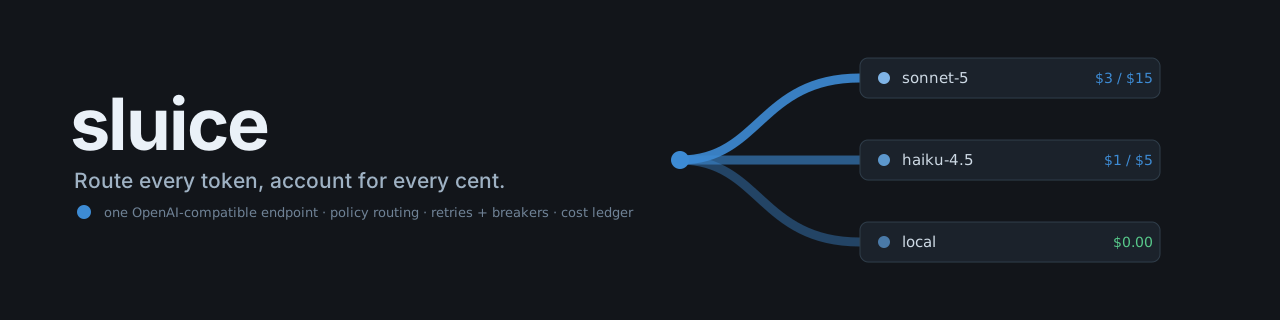
Route every token, account for every cent.
Teams that only ever call one hosted model API tend to have no answer to two questions: what does a single request cost, and what happens when the provider rate-limits or goes down. Sluice exposes one OpenAI-compatible endpoint and, per request, decides which backend should serve it: a free local llama.cpp server, Claude Haiku, or Claude Sonnet. Every request gets a deterministic, explainable routing decision, per-request cost accounting in a SQLite ledger, retries with backoff, fallback chains, circuit breaking, and OpenTelemetry traces.
source: ./scripts/demo.sh run 2026-07-07 · Apple M4 Pro 24 GB · LFM2.5-1.2B Q4_K_M via llama-server (Metal) · ANTHROPIC_API_KEY unset · ledger output verbatim below
Hosted gateways (Vercel AI Gateway, OpenRouter) already do provider failover and cost/latency routing, so Sluice is not trying to be a SaaS gateway. It is the self-hosted, auditable version for teams that cannot send every request through a third party (on-prem, VPC, data-residency, a local model in the mix) and want the routing policy and the cost ledger to be code they own and can reason about, not a dashboard.
A deterministic complexity heuristic assigns a tier: complex for tool use or ~1500+ estimated tokens, moderate for code markers or 300+ tokens, simple otherwise.
(policy, tier) looks up a backend chain in sluice.yaml. Policy comes from X-Sluice-Policy (cheap, balanced, quality). Every default chain ends in local, so the gateway degrades to free inference instead of failing.
X-Sluice-Max-Cost-USD drops backends whose pre-flight estimate exceeds the cap; dropped backends are named in the route reason. X-Sluice-Latency-Budget-Ms sets a request deadline that clamps timeouts and skips doomed retries.
Per-backend circuit breakers, exponential backoff with jitter on 429/5xx/timeouts, fallback to the next backend in the chain, per-backend timeouts. The winner's hop count lands in the ledger as fallback_hops.
Every request is recorded in SQLite: backend, model, real token counts from upstream usage, estimated cost at real per-MTok prices, latency, route reason, status. Answers arrive with X-Sluice-Backend, X-Sluice-Est-Cost-USD, and X-Sluice-Route-Reason headers.
         POST /v1/chat/completions
                    |
           +-----------------+
           |  route-decision |  complexity heuristic -> tier
           |     (span)      |  policy + tier -> backend chain
           +-----------------+  max-cost cap filters the chain
                    |
      chain: [claude-haiku, local]
                    |
  +-----------------v------------------+
  |         execution engine           |
  |  per-backend circuit breaker       |
  |  retries: exp backoff + jitter     |
  |  fallback to next backend in chain |
  |  per-backend timeout / deadline    |
  +----+----------------+---------+----+
       |                |         |
 +-----v----+    +------v-----+   +----------+
 |  local   |    |  anthropic |   |  openai- |
 | llama.cpp|    |  (sonnet,  |   |  generic |
 | $0/MTok  |    |   haiku)   |   |          |
 +----------+    +------------+   +----------+
Two artifacts back every claim: 61 offline tests that assert backoff sequences, breaker transitions, fallback ordering, cost-cap drops, deadline 504s, streaming, and both directions of the Anthropic translation exactly; and a demo script whose ledger output is reproduced here unedited. One request in the batch took a real 401 from api.anthropic.com and fell back to local in the same request.
By backend
  key     reqs  ok  prompt_tok  compl_tok  cost_usd  p50_ms  p95_ms  tok_s
  local      7   7         240        297  0.000000   233.0   697.0  130.2

Totals
  requests            7
  ok                  7
  with fallback hops  1
  total cost usd      0.000000
  p50 latency ms      233.0
  p95 latency ms      697.0
policy=quality tier=simple signals=[prompt~16tok] chain=local
  dropped=[claude-haiku(est=$0.000616>cap=$0.000000),
           claude-sonnet(est=$0.001232>cap=$0.000000)]
backend                       in $/MTok  out $/MTok  batch cost
local (measured)                   0.00        0.00   $0.000000
claude-haiku-4-5 (estimate)        1.00        5.00   $0.001725
claude-sonnet-5 (estimate)         2.00       10.00   $0.003450

# estimates use the local model's token counts at the
# per-MTok rates in sluice.yaml; Anthropic tokenizers
# differ, so treat them as order-of-magnitude.
The absolute numbers are tiny because the batch is tiny; the point is the mechanism. The ledger prices every request at the serving backend's real rates, so at production volume the report directly answers what routing policy X cost today.
All 61 tests run offline against fake backends. The demo needs a GGUF and a built llama.cpp; rerunning it regenerates every number on this page on any machine.
$ uv sync
$ uv run pytest        # 61 tests, all offline
$ MODEL=path/to/model.gguf ./scripts/demo.sh
$ uv run sluice serve  # http://127.0.0.1:8091
$ uv run sluice report # cost/latency from the ledger
$ curl http://127.0.0.1:8091/v1/chat/completions \
    -H 'Content-Type: application/json' \
    -H 'X-Sluice-Policy: balanced' \
    -H 'X-Sluice-Max-Cost-USD: 0.002' \
    -d '{"messages":[{"role":"user","content":"hi"}],
         "max_tokens":100}'
tool role messages (tool results in the conversation) are not translated.This section is not small print. A latency number without its failure modes is an advert, and this page is a datasheet.